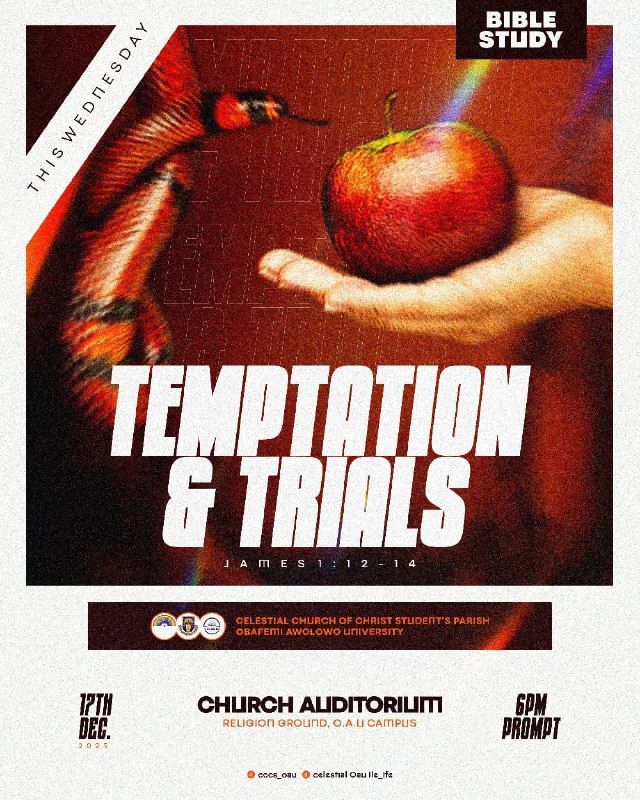
TOPIC: TEMPTATION AND TRIALS
ANCHOR TEXT: James 1:12-14
James 1:12 Blessed is the man who perseveres under trials, because when he has stood the test, he will receive the crown of life that God has promised to those who love him.
James 1:13 And remember, no one who wants to do wrong ever say, “God is tempting me.” God is never tempted to do wrong, and he never tempts anyone else either.
James 1:14 but each one is tempted when, by his own evil desire, he is dragged away and enticed.
AIMS:
- To understand the difference between temptation and trials
- To know why we face temptation and trials
- To learn the endpoint of temptation and trials
INTRODUCTION
Have you ever wondered why, just when you decided to get serious with God, life suddenly seems harder? The moment you choose to pray more, you feel more distracted. The day you decided to forgive, someone offends you over again. You make a commitment to live holy, and suddenly you are faced with all sorts of offers and situations you thought you had left behind. When you ask God to grow your faith, life throws challenges at you. We live in a world that constantly tests us, sometimes through difficult situations that stretch our faith (trials), and sometimes through appealing offers or desires that try to pull us away from God (temptations). The truth is, none of us can escape them. Whether you are young or old, rich or poor, new in faith or a seasoned Christian, you will face both. The Bible makes us understand in 2 Timothy 3:12: “In fact, everyone who wants to live a godly life in Christ Jesus will be persecuted”. In other words, challenges are not strange; they are expected for every true believer.
Beloved, that is because the Christian journey is not a walk in the park. It’s a battleground, and in this battle, two forces will always cross our path: temptations and trials.
DIFFERENCE BETWEEN TEMPTATIONS AND TRIALS
The Greek word for both “trials” and “temptations” is Peirasmos, which means to test, try, or tempt. It carries a dual meaning of a difficult situation that tests faith (a trial) or an enticement to sin (a temptation). The specific meaning of Peirasmos is determined by the context, as it can be a test from God to strengthen faith or a lure towards evil from internal desires or external sources.
Understanding Temptations
Temptation by comparison, is internal. Individuals can only be tempted with that which is individually tempting to that person. Some struggle with stealing, some with lust, others with lying. Once again the book of James clarifies in chapter 1 verse 14, “But each person is tempted when he is lured and enticed by his own desire.”
The book of Matthew 4, explain the temptation of Jesus in the wilderness. After fasting for forty days, Satan came to Him, appealing to His natural hunger, His eyes, and His position as the Son of God. He was tempted to turn stones to bread, to bow and gain the kingdoms of the world, and to throw Himself down from the temple. These temptations connect to what John describes as “the lust of the flesh, the lust of the eyes, and the pride of life” (1 John 2:16). Yet Jesus did not fall. He overcame by standing firmly on the Word of God, answering each enticement with, “It is written”, His victory shows that temptation is resisted by depending on God’s Word and not on our own strength.
In contrast, the first man and woman, Adam and Eve, fell into temptation in the Garden of Eden. The serpent deceived Eve into looking at the forbidden fruits differently. She saw that it was “goof for food,” which appealed to the lust of the flesh. She noticed it was “pleasant to the eyes,” which was the lust of the eyes. An she considered that it “desirable to make one wise,” which fed into the pride of life (Genesis 3:6).
Unlike Jesus, Adam and Eve yielded to the desire stirred in their hearts, and the disobedience brought sin and death into the world (Romans 5:12). Temptation are enticements to sin that come from three sources: The world, our own sinful desires (the flesh) and the devil. The ultimate goal is our destruction.
Understanding Trials
While many know the Book of James for its discussion of good works, it provides one of the most concise definitions of a trial. In James 1:2-3 the Bible says, “Count it all joy”, my brothers, when you meet trials of various kinds, for you know that the testing of your faith produces steadfastness.” So a trial is a testing of our faith. It is a moment used by God for our growth, and to draw us closer to Him. Trials come in many forms, but they typically come in the form of an outside force beyond the individual’s control. Illness, fire, accidents, and job loss are easily recognizable as bad moments in life, but God is sovereign over those times.
The story of Job in the Old Testament shows us a clear example of a trial. Job was a man described as upright and blameless, yet he lost his wealth, his children, and even his health in a short span of time. What he went through was not a temptation to sin but a trial permitted by God to test and refine his faith, In the midst of his suffering, Job declared, “Though He slay me, yet will I trust in Him” (Job 13:15). His trials did not end in destruction but in resurrection, as God blesses him with double in the end (Job 42:10) This reveals that trials are meant to strengthen us and prove the genuineness of our faith.
WHY WE FACE TEMPTION AND TRIALS
Think about your academic journey, After attending weeks of classes, listening to lectures, and studying course materials, you eventually face examination. Why? The test doesn’t teach you new information, rather it reveals what you have learned. It assesses whether you truly understood the lessons, whether you can apply the knowledge, and whether you’re ready to advance to the next level.
In the same way, God allows us to face temptations and trials not because He wants us to fail, but because He wants to reveal, refine, and mature us. Just as a teacher examines students to assess their growth, God allows testing in our lives to develop our faith and prove its genuineness.
WHY WE FACE TEMPTATIONS
- Sinful nature (Romans 5:12): When Adam and Eve disobeyed God in the Garden of Eden, Sin entered humanity like a genetic disease passed down through generations. Every person born after Adam inherited this fallen nature. 1 John 2:16 (The lust of the flesh, lust of the eyes, and the pride of life)
- Weakness of the Flesh (Matthew 26:41): Jesus spoke these words to His disciples in the Garden of Gethsemane. Notice the contrast: the Spirit (Our renewed inner man) is willing to obey God, but the flesh (our human nature and physical body) is weak.
- Sinful Desire (James 1:14-15): James describes temptation using a fishing metaphor. Sin doesn’t chase us down and force us to obey. Instead, it lures us like a fish to a hook. The progression of temptation is from Desire to Enticement, to Conception to Birth to Death (practical examples of this progression is illustration David’s sin with Bathsheba in 2 Samuel 11).
- Failure to Submit to God (James 4:7): When we fail to maintain our spiritual disciplines such as Prayer, Bible study, Fellowship and Worship will open doors for temptation to thrive. Spiritual drift doesn’t just happen overnight.
WHY WE FACE TRIALS
- To Test and Refined Our Faith (James 1:2-4): Trials are God’s tools for refining our faith like gold is refined in fire. The heat doesn’t destroy the gold; it purifies it by burning away impurities. 1 Peter 1:6-7, Job 13:15.
- To Produce Spiritual Maturity and Christlikeness: Consider a new believers who gets baptized and expects life to become easy. Instead they face increased opposition from family, financial pressures, and spiritual warfare. They might wonder, “Why is God allowing this?” The answer is that, God is transforming them from spiritual infants into mature believers who can handle greater assignments for His kingdom. Hebrews 12:6.
- To Teach Us Complete Dependence on God (2 Corinthians 12:9): Trials strip away our self-sufficiency and teach us that we are not sufficient in ourselves (Proverbs 3:5). When we reach the end of our strength, we discover God’s unlimited strength.
- To Prepare us for Greater Kingdom Assignments (James 1:12): God tests us at one level to prepare us for the next level. Every biblical hero such as Joseph, Moses, David, Jesus faced trials before promotion.
THE ENDPOINT OF TEMPTATIONS AND TRIALS
Imagine you are standing at a train station with two platforms. On Platform A, trains depart toward the city center (a place of prosperity, celebration, and abundant life). On Platform B, trains head towards a desolate wasteland (a place of ruin, destruction and death). Both trains leave from the same station, but they arrive at completely different destinations. The critical question is not which platform looks more appealing in the moment, but where each train will ultimately take you.
Every journey has an endpoint; a final destination or outcome. When you enroll in a school, the end point is graduation. When you plant a seed, the endpoints is harvest. When you board a plane, the endpoint is your destination city. Similarly, when you face temptations and trials, there is an endpoint; a final outcome that
depends entirely on how we respond.
Endpoint of Temptation:
Temptation, when yielded to, leads to a clear and destructive path described in the book of (James 1:14-15) This passage reveals temptation occurs when a desire with us receive encouragement to act, and when we say yes to the desire instead of trusting and obeying God, sin is born. James uses the metaphor of conception and birth to show the deadly progression
- Evil desire/Lust: The process begins internally, not externally. The Greek word translated “desire” is epithumia, referring to our natural, fallen craving that pulls us away from God’s will. God cannot be tempted by evil, and He does not tempt anyone to do evil. Eve’s desire was enticed by The lust of the flesh (good for food), The lust of the eyes (pleasant to look at) and The pride of life (desireable to make one wise) Genesis 3:6
- Enticement and Conception: Temptation plays on desire, manipulating if for the specific purpose of enticing us to carry out a sinful act. The word “enticed” is like a fish being lured by bait. 2 Corinthians 10:5 warn us to “Take every thought captive to obey Christ”
- Sin is Born: When desire is acted upon, it gives birth to sin. This moment when thought becomes action, when internal desire manifest in external disobedience. Temptation is not sin, sin happens when you “buy” the goods being sold by the devil.
- Sin Grows to Maturity: Sin does not remain small and harmless. When left unconfessed and unrepented, it grows, spread, and gains power over us.
- Death- The final Endpoint: Sin When it is full grown, bring forth death (physical or spiritual death) which birth forth loss of joy, and peace, prayers feel empty, spiritual sensitivity is dulled, cannot hear God’s voice clearly.
Endpoint of Trials
Glorifying God (1 Peter 1:6-7)
Approval and reward (Crown of Life) James 1:12
Spiritual Maturity (James 1:3-4)
Conformity to Christ (Romans 8:29)
Growth and Strength (Ephesians 3:16)